


TL;DR: Session cookies for scraping can turn a browser from the main extraction engine into a short setup step. On one Akamai-class marketplace, cold direct requests produced about 0% usable responses. After one browser visit established session state, direct HTTP replays reached 98–100% across batches of fresh exit IPs. One warm session then supported hundreds to thousands of lower-cost requests. This is a measured pattern, not a universal rule: a site can still bind state to an IP, device, TLS fingerprint, or behavior.
Introduction
A scraper does not always need a browser to render every page. Sometimes it needs a browser only long enough to establish the state that a direct HTTP client is missing.
On a protected site, misdiagnosing that role wastes days. A team can change headers, TLS fingerprints, client libraries, and network routes while every cold request still receives the same rejection. That happened in this test because the missing variable was application state, not another client profile.
The decisive variable was the session created during an ordinary landing-page visit. Once the scraper carried that state forward, a cheaper HTTP path could handle the repetitive work. The browser became a session initializer, not a page-by-page dependency.
The browser visit left behind the variable that mattered: an accepted session. We isolated it, tested it across fresh network exits, and measured the browser work that the direct path could replace.
Cold Requests Failed Across the Tested Clients
The initial symptom looked like a fingerprint problem. A deep public endpoint returned a rejection before the response contained usable content. Changing the apparent browser family did not improve the result. Neither did rotating through fresh network exits.
We tested the request under several Chrome-, Firefox-, and Safari-style client profiles while holding the target resource and acceptance check constant. Cold direct requests stayed near 0% usable.
Three approaches failed to solve the actual constraint:
- Swapping client profiles changed the handshake but did not establish application state.
- Rotating IPs changed the network identity but did not satisfy the session gate.
- Running every page in a full browser worked, but it paid browser cost on every request.
The third result provided the useful clue. If a browser could open the page, the next question was not how to imitate every browser detail. It was which part of the browser visit remained useful after the page loaded.
The Missing Variable Was Session State
Web cookies exist to carry state between requests. Under RFC 6265, a server sends Set-Cookie, the user agent stores the value with attributes such as domain, path, expiry, and Secure, and later requests return the applicable values in a Cookie header.
Akamai's own Bot Manager documentation says its standard web-client telemetry uses first-party cookies to associate and transmit user behavior data. That does not mean one named cookie unlocks every Akamai-protected site. It does explain why a cold deep request and a request made after normal navigation can receive different treatment even when the URL, IP class, and apparent browser profile look similar.
We tested the next hypothesis: visit an allowed landing page once in a browser, preserve the resulting session state, and see whether a direct HTTP client could use it for later public requests.
It could.
What We Measured
We kept the endpoint and usable-response validation constant. A response counted as usable only when it contained the expected content shape, not merely when it returned HTTP 200. Each comparison used fresh sessions where the phase required them, and the replay phase covered batches of five to eight fresh exit IPs.
| Phase | Request path | Observed usable-response rate | What the result isolated |
|---|---|---|---|
| Cold deep request | Direct HTTP across tested client profiles and fresh exits | About 0% | Fingerprint and IP changes alone did not establish the required state |
| Browser warm-up | One normal landing-page visit | Session established | Initial navigation created state accepted by the site |
| Warm-state replay | Direct HTTP with the established state across five to eight fresh exits per batch | 98–100% | In this case, the accepted state mattered more than the warm-up IP |
| Rejected or aged state | Refresh the session, then repeat the replay test | About 100% after refresh | Session freshness was an operating variable |
These figures describe one large international marketplace with an Akamai-class protection flow. They are not an Akamai-wide benchmark. The valuable finding is the size of the change under controlled conditions: the direct path moved from effectively unusable to consistently usable when session state was the variable we changed.
The Warm-Up and Replay Architecture
The safe architecture has four jobs: establish state, hand it to the lower-cost path, validate every response, and refresh state when validation fails.
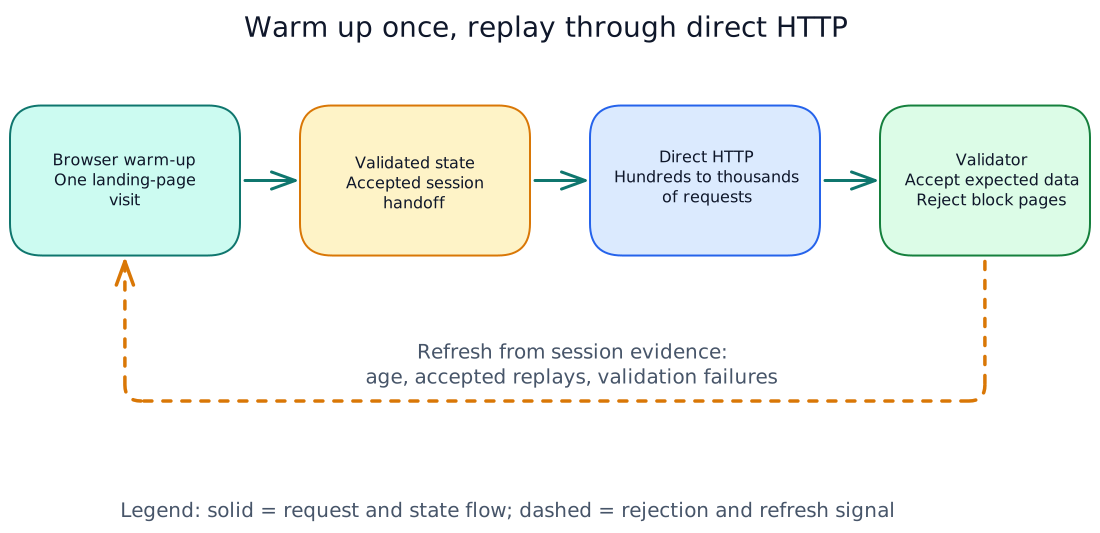
1. Establish a session through normal navigation
Open a permitted landing page in a full browser context and wait until the site has completed the navigation needed to establish a valid session. Do not treat a page-load event alone as proof. The output of this step is validated session state.
Modern browser automation libraries expose that state directly. For example, Playwright's browserContext.cookies() returns cookies for the context, while storageState() can include cookies and other browser storage. Move only the state that controlled tests show the next stage needs.
2. Replay with a direct HTTP client
Send the repetitive page or API requests through a lower-cost HTTP client while carrying the accepted session state. Keep request construction consistent enough that the server sees a coherent session. The browser is no longer rendering every response, executing every script, or holding a tab for every URL.
3. Validate content, not status codes
A protection page can return HTTP 200. A partial response can look successful to a transport-level monitor. Validate a stable content marker, schema, or record count before accepting the response.
This check belongs on every replay because it drives the refresh decision. Without it, a scraper can store challenge pages as data and report a healthy success rate.
4. Refresh when the state stops working
Treat session state as perishable. When a request fails the content check, stop assigning new work to that state, establish a fresh session, and retry within a bounded policy. Track the age and acceptance history of each session so refreshes happen from evidence rather than a fixed guess.
This is enough to define the system boundary. The exact cookie identities, header set, browser profile, and refresh thresholds depend on the source and should come from controlled tests.
The Economics Come From Amortizing Browser Work
Browser execution has a place in scraping. It handles JavaScript, interactive flows, and state creation that direct clients cannot reproduce. It also consumes more memory and CPU per request, and page rendering adds latency that an HTTP client avoids.
The warm-up pattern changes the unit economics by spreading one browser navigation across many accepted replays.
| Architecture | Browser work for N page requests | Direct HTTP work | Main cost driver | Use it when |
|---|---|---|---|---|
| Browser for every page | N navigations | Little or none | Rendering and browser concurrency | Each page needs browser-only execution or interaction |
| Warm up, then replay | One warm-up plus evidence-based refreshes | Up to N requests | Session lifetime and refresh frequency | A browser-created session unlocks stable direct responses |
| Direct HTTP only | None | N requests plus retries | Failed cold attempts if a gate exists | The resource accepts stateless requests |
If one warm-up supports 1,000 accepted replays, the scraper spends 0.001 browser navigations per accepted page before refresh overhead. If the state survives only 50 replays, that figure rises to 0.02. The architecture still may win, but session lifetime now dominates the calculation.
Measure four quantities before choosing the design:
- Accepted replays per warm-up.
- Browser time and compute per warm-up.
- Direct-request latency and compute.
- Refresh and retry rate under normal load.
The comparison should use accepted pages, not attempted requests.
Reliability Depends on Session Evidence
A warm session is an operating resource. The system needs to know whether it is accepted, aging, or rejected.
Useful signals include:
- time since the session was established;
- number of accepted replays;
- recent content-validation failures;
- response-shape changes;
- refresh frequency by source and request class.
Do not refresh every session on a global timer unless measurements support that policy. A fixed timer can discard useful state too early or keep failed state active too long. Refresh after a validation failure, then use the collected lifetime distribution to set proactive limits where they reduce retries.
At larger scale, keep the browser initializer and HTTP workers behind one delivery contract. Downstream consumers should receive validated records without knowing which engine handled the request. That separation also makes it easier to route the small fraction of pages that still need browser execution.
Where This Pattern Works, and Where It Does Not
The pattern is a good candidate when normal navigation creates a session, later public resources accept that state, and the state lasts long enough to amortize the warm-up. It is especially useful when direct responses contain complete HTML or structured data and do not require browser-side rendering for every page.
It is a poor fit when:
- each request requires a fresh JavaScript proof;
- the server binds state tightly to IP, TLS, device, or a browser process;
- the page content exists only after client-side execution;
- the workflow depends on interactive authentication or personal data;
- session lifetime is too short to repay the warm-up cost.
What This Changes in Scraper Design
When every cold direct request fails and a browser succeeds, diagnose what the browser contributed before leaving it in the hot path. Test rendering, interaction, fingerprint fidelity, and session establishment as separate variables.
If state creation is the only durable contribution, isolate it as a short control-plane step. Let direct HTTP handle the data-plane volume, and keep validation between the two.
On the marketplace measured here, that change moved usable direct responses from about 0% to 98–100% and let one warm session support hundreds to thousands of requests. The result held across fresh exit IPs in our test, but the architecture remains honest only when each new source earns the same conclusion through measurement.
FAQ
Can you scrape without a browser after warming up a session?
Sometimes. If the browser's main contribution is accepted session state and later pages return complete data to a direct client, the browser can leave the request hot path. Keep content validation in place because a status code alone does not prove that the session still works.
Are session cookies tied to an IP address?
Not by the cookie protocol itself. A server can still bind the session to an IP or other signals on the server side. In this measured case, the established state remained accepted across batches of fresh exit IPs.
How long does a warmed session last?
There is no universal lifetime. Cookie expiry provides one boundary, but the server can reject state earlier. Measure accepted replays, age, and validation failures, then refresh from evidence.
Does this work on every Akamai-protected site?
No. Akamai deployments and site policies differ. Some flows use first-party cookies as part of client telemetry, while others also require per-request signals or server-side binding. Treat this as a hypothesis to test, not a preset.
Is copying cookies always enough?
No. A working browser context may also contain local storage, IndexedDB state, or server-side associations. Playwright exposes these categories separately for a reason. Transfer only what controlled tests show is required, and reject any replay that fails the content check.

